We'll drive to Richmond for a flight to Houston, followed by the overnight flight to Buenos Aires. We land at the international airport and will transfer downtown, about an hour away, to the Hotel Boutique Recoleta.
Recoleta is a downtown residential neighborhood in the city of Buenos Aires, Argentina; it is an area of great historical and architectural interest, principally because the Recoleta Cemetery is located there. It is also an important tourist destination and cultural center of the city. It is also considered one of the more affluent neighborhoods, and the
cost per square meter/foot of real estate is one of the highest in the
city. it is the district chosen by the most exclusive brands in the world,
plenty of art galleries, restaurants, museums and exhibition centers.
There are excellent restaurants with outdoor seating allowing patrons to enjoy the December sunshine and warmth. Steaks are world-famous and affordable and Argentinian wine flows freely. Nate and I enjoyed a wonderful dinner in Recoleta on our visit to BA. Many tango lyrics reflect life in the Recoleta neighborhood. See the Naional Geographic walking tour.
The hotel is a suites hotel. Our 25m²-one-room suite is decorated with contemporary furniture and fully
equipped. Single or double bed, kitchenette (including dishware,
portable stove, convection oven and mini-bar with in-room refreshments) complements a
fully-equipped bathroom with bathtub.
The next day (8th) we will take an afternoon flight from the nearby national airport to San Carlos de Bariloche, the jewel of Patagonia, which sits amongst Andean lakes. We'll stay at the lakefront Hosteria del Lago in the lively downtown area with views of the Andes across Nahuel Huapi Lake. On the 10th we will begin our journey to Chile with a boat excursion across the lake then a short bus ride then another lake crossing in the high Andes to Peulla. We spend the night at Hotel Natura Patagonia or Hotel Peulla, leaving the next afternoon for sailing on Lake Todos los Santos. Afterwards we visit
the Falls of Petrohué enjoying the capricious shapes
of volcanic rock, bathed in green waterfalls before continuing on the border of Lake
Llanquihue, Chile's largest lake, Towering over the lake is Osorno Volcano providing breathtaking views. We arrive at the conference where we are staying at Dreams of the Volcanoes Hotel. The conference continues through 15th December; we have Sunday 16 Dec free. We leave from nearby Puerto Montt on the 17th, flying though Santiago, Buenos Aires and Houston back to Richmond, arriving at 10am on the 18th.
Wednesday, October 24, 2012

Sunday, October 21, 2012
October Oysters
 |
| Sorting the 500 oysters, larger ones in the bucket, smaller ones on the left. |
 |
| Darby and I sort oysters. |
 |
| A great deal of life enlivens the oyster environment including this worm--we tried to wash them away. |
 |
| Some of the larger oysters could be eaten now. |
 |
| Emptying the oyster bag for sorting, |
I moved the float to the shady northern side of the pier in order to try to cut back the algal growth. With the sun low for the winter it isn't possible to get it very far under the pier but hopefully growth is curtailed in the winter months.
Sunday, September 23, 2012
Oyster update
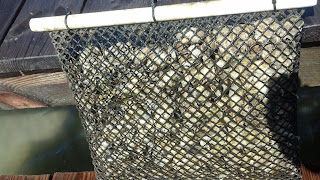
Checked on the oysters today, a cool and blustery day after a front came through after dark last night. We had some Rappahannock River oysters, some Stingray Point oysters and some Old Salts yesterday at Merroir at Locklies. One delicious one had two babies on his back so I brought them home to lie in my oyster pot. I checked up on it though it has only been two weeks since the last checkup. They look fine, about 2-2.5" in size.
 I also put the crab pots out just before sunset last night. Remarkably, we have seven crabs at noon the next day. Sweet red pepper and crab soup? or just pick them? This may be the last crabbing of the season, this first full day of Fall.

Sunday, September 9, 2012
Oyster update
On Memorial Day 2011 I bought an oyster float and young oysters (spat) from oystergardner.com and secured them under my dock. They had reached about 1.5" size when Hurricane Irene struck. Although the float remained, the oysters were all gone (they were in an insert). As the package weighed at least ten pounds, I rather suspect they were stolen but in any event they were gone.

In May 2012 I bought a new bag of spat from Tom and placed them into the float. By July they had grown nicely and I moved them up to the next larger size insert. This weekend they were ready for the next larger size insert, as they had grown to 1.5-2" in size (most of them anyway). The insert plus its cargo now weighs about ten pounds--a fair amount of CO2 has been converted to calcium carbonate! Besides decreasing the atmospheric carbon load, the oysters also filter and clean the Bay. These are located at the confluence of Sturgeon Creek with the Rappahannock River, near the River's confluence with the Bay. One can see the float and the insert in the photo--a later photo of the hummingbird feeder shows the waterways flowing together to the Chesapeake Bay in the distance.
 Here you can see the oysters in the old insert, which is covered in growths. There are also small crabs, worms of various kinds, sea grapes (gelatinous creatures--(Molgula manhattensis)), sea lice, shrimp, barnacles and goo. I transferred the oysters into a new insert with a larger mesh which should allow better circulation.
 Here they are migrating to the new mesh insert. For scale, the boards on the pier are 6" wide. The larger oysters have already grown to about 2" in size. When this began in May they were the size of my pinky nail and all 500 fit into a tiny bag the size of my fist.
 Finally they are all in, fastened and ready to go back into the drink. They had been on the beach for about two hours, recommended as although they oysters can exist happily out of water that long, some worms which are their predators cannot, so the theory is that the worms die during this time.
Now I restored them to the float for the next month or so of growth, at which point I'll bring them out again, rinse them off and wipe out another set of worms. Oops! Three smaller fellows remained in the old float. Some of the oysters didn't grow as well as others. Perhaps that is because they are crowded. I decided to put these smaller three into a separate insert, an old onion bag.
 You can see how much smaller these were. In fact, there were some smaller still. We will see if they can catch up on their growth in this more commodious accommodation.
It is the end of the season for many migratory birds, so I made up a new batch of nectar for the hummingbirds after cleaning out their feeder. They may be gone the next time I get down to Slacktide.
 Lastly I decided to harvest the apples. All three of them. Well, actually, only two. The best one is always just out of reach. I had one for lunch--it was delicious. The only other nearby apple tree is about 500 feet away and is in the last stage of its life, so mine didn't get much pollen this year. I need to plant another tree if I want more fruit!


In May 2012 I bought a new bag of spat from Tom and placed them into the float. By July they had grown nicely and I moved them up to the next larger size insert. This weekend they were ready for the next larger size insert, as they had grown to 1.5-2" in size (most of them anyway). The insert plus its cargo now weighs about ten pounds--a fair amount of CO2 has been converted to calcium carbonate! Besides decreasing the atmospheric carbon load, the oysters also filter and clean the Bay. These are located at the confluence of Sturgeon Creek with the Rappahannock River, near the River's confluence with the Bay. One can see the float and the insert in the photo--a later photo of the hummingbird feeder shows the waterways flowing together to the Chesapeake Bay in the distance.


Now I restored them to the float for the next month or so of growth, at which point I'll bring them out again, rinse them off and wipe out another set of worms. Oops! Three smaller fellows remained in the old float. Some of the oysters didn't grow as well as others. Perhaps that is because they are crowded. I decided to put these smaller three into a separate insert, an old onion bag.

It is the end of the season for many migratory birds, so I made up a new batch of nectar for the hummingbirds after cleaning out their feeder. They may be gone the next time I get down to Slacktide.


Sunday, March 25, 2012
The flowers bloom

Most of the bulbs have bloomed now. Here is a view as of 15 March. The Webber's Parrot tulips also bloomed.

Saturday, October 22, 2011
Daffodils

Brackenhurst
Sunproof 3 to 5 inch blooms with bright yellow petals and bowl-shaped cups of intense orange pack a visual punch. Perennializes well and has a very long blooming period. Winner of the American Daffodil Society Wister Award for outstanding garden merit.
Planted SE front corner of bed at head of driveway.

Delibes
Perfectly formed blooms have primrose-yellow overlapping petals and large, shallow, vivid yellow cups that shade to orange at their rims. A strong multiplier and reliable perennial. American Daffodil Society Wister Award winner for outstanding garden merit.
Monal
Rich golden-yellow overlapping petals frame a scorching red-orange funnel- shaped cup. A strong growe
 r that forces with little cold period. From U.S. hybridizer Grant Mitsch. American Daffodil Society Wister Award recipient for outstanding garden merit.
Planted SE front right of center of bed at head of driveway.
Bloom Time: Early
Fragrant: No

Tripartite
This fragrant multi-bloomer produces 2 to 4 exquisite, butterfly-like, lemon-yellow blooms on each stem, each flower with overlapping petals and a large, disk-shaped split cup. An American Daffodil Society Wister Award recipient for outstanding garden merit. Collar type.
Planted east side of bed at head of driveway 11/6/2011.
Bloom Time: Mid/Late Spring
Fragrant: No

Ziva
Each bulb of this reliable strain yields as many as 4 stems, each producing grand clusters of spicy scented pure white flowers. Foliage is upright and bright green, reaching 16 to 18 inches. The earliest Tazetta to bloom and very easy to force.
Tulip
Weber's Parrot
Description: Parfait
 blossoms of creamy white are streaked and edged with soft pink. A touch of green accents the base. Weber’s Parrot blooms in mid-late spring on 16-inch stems.
Ships: Between 10/27/2011 and 12/02/2011
Bloom Time: Late Spring and Mid-Spring
Color: Cream and Pink
Foliage Color: Green
Height: 12-24"
Sun Requirements: Full Sun
Planted back east side of bed at head of driveway.
Subscribe to:
Posts (Atom)